
Casinos That Accept Google Pay in Australia
 Available in AU
Contents
A familiar wallet at physical checkouts does not confirm online casino support, and deposit availability does not guarantee withdrawals.
Google Pay at Online Casinos: What Offline Acceptance Does—and Doesn’t—Tell You
In Australia, paying with a phone at a shop has become ordinary. Mobile wallets, including Google Pay and Apple Pay, are accepted by businesses across almost the whole country. I can see why that familiarity makes the same option sound like a natural fit for an online account. But a shop accepting a tap from your phone and an online gambling service accepting Google Pay are separate things.
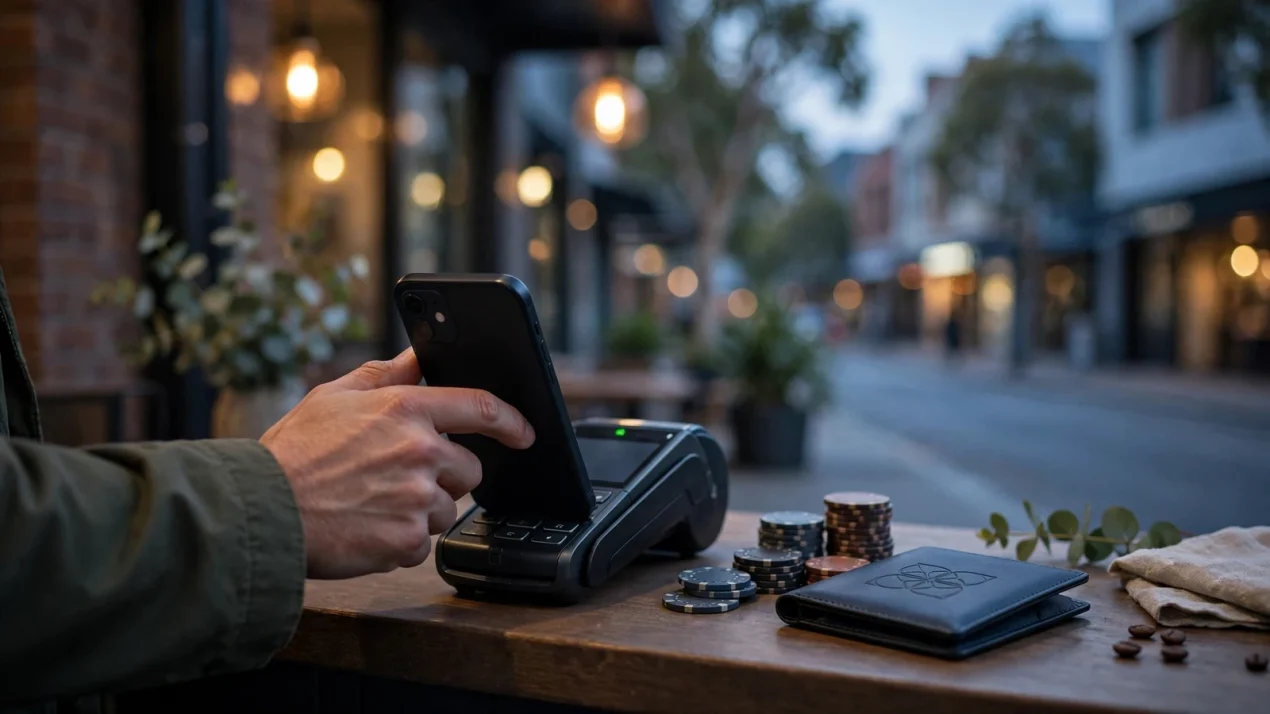
That distinction is easy to miss because the name is the same. At a physical checkout, you may bring your phone close to a reader and complete a purchase. Seeing Google Pay offered there tells you that the wallet is useful in that setting. It doesn’t establish that an online casino offers it, or that a particular site would handle a payment through it. One kind of acceptance does not carry over automatically to another.
I’ve been caught by this sort of assumption with payment options before: a familiar logo looks like a promise, when really it only tells you something about the place displaying it. “Widely accepted” can sound like “accepted everywhere.” It isn’t the same statement. A wallet can be common in Australian shops without being a standard option for every online service.
If you want to pay with Google Pay in Australia, check that the cashier explicitly offers it before depositing, as payment options can vary. Use these details as a starting point, not confirmation that Google Pay is supported.
1. DragonSlots Casino
License: Curacao Gaming Authority (Jumpman Gaming Ltd)
DragonSlots Casino is listed with a Curacao Gaming Authority licence held by Jumpman Gaming Ltd. The supplied details do not confirm whether Google Pay is available.
2. Wild Tokyo
License: Curacao · Payout speed: crypto 30-60 minutes, fiat 1-5 days · Min. deposit: A$10
Wild Tokyo lists a A$10 minimum deposit and payout speeds of 30–60 minutes for crypto and 1–5 days for fiat. Google Pay availability is not specified in the supplied details.
3. House of Pokies
License: international iGaming licence – jurisdiction not named in the source · Payout speed: PayID 1-24 hours · Min. deposit: A$30 (PayID from A$10)
House of Pokies lists PayID payouts in 1–24 hours and a A$30 minimum deposit, or A$10 for PayID; its licence jurisdiction is not named in the source. The supplied details do not say whether it accepts Google Pay.
4. Uptown Pokies
License: Curacao (operating since 2017) · Min. deposit: A$20
Uptown Pokies is listed as operating since 2017 under a Curacao licence, with a A$20 minimum deposit. Google Pay support is not specified.
5. Bizzo Casino
License: Curacao Gaming Control Board (TechSolutions Group N.V.)
Bizzo Casino is listed with a Curacao Gaming Control Board licence held by TechSolutions Group N.V. The supplied details do not confirm Google Pay availability.
6. Lucky Dreams
License: Curacao · Min. deposit: A$20 (POLi)
Lucky Dreams lists a A$20 minimum deposit for POLi. Its supplied details do not establish whether Google Pay is accepted.
7. JeetCity Casino
License: Curacao eGaming (Dama N.V.)
JeetCity Casino is listed with a Curacao eGaming licence held by Dama N.V. No Google Pay information is provided.
8. Thor Casino
License: Curacao – Antillephone N.V. (Versus Odds B.V.) · Min. deposit: EUR 20
Thor Casino is listed with a Curacao licence from Antillephone N.V. (Versus Odds B.V.) and a EUR 20 minimum deposit. Google Pay availability is not stated in the supplied details.
9. JustCasino
License: Curacao Gaming Control Board
JustCasino is listed with a Curacao Gaming Control Board licence. The supplied details do not specify whether Google Pay is available.
10. WinSpirit Casino
License: Curacao eGaming OGL/2024/923/0383 (Antillephone N.V.) · Min. deposit: A$30
WinSpirit Casino is listed with a Curacao eGaming licence, OGL/2024/923/0383, from Antillephone N.V., and a A$30 minimum deposit. The supplied details do not confirm Google Pay support.
So if you are wondering whether Australian online casinos accept Google Pay, keep the question narrow. The fact that Australians can use mobile wallets in day-to-day shopping doesn’t answer it. It does not identify any particular service, confirm that Google Pay is offered there, or establish whether its use would be permitted for the activity in question. It says something about everyday retail payment habits, not about an online gambling account.
That may feel like a fussy distinction, but it matters when you are deciding what a payment label means. A logo on a shop counter and a wallet listed for an online transaction are not interchangeable evidence. Nor does the general popularity of phone payments turn an online service into a place where the wallet can necessarily be used. I wouldn’t treat familiarity as confirmation.
There is another reason to avoid reading too much into the comparison: online casino services are not simply another category of Australian shop. Under the Interactive Gambling Act 2001, it is illegal for operators to provide real-money online casino games to people physically located in Australia. The Australian Communications and Media Authority is responsible for enforcing that law. The legal setting is therefore not something to skip over just because a payment method is familiar.
Australian consumer law does not protect players who use offshore casinos. That is worth keeping in mind before treating an online casino as an ordinary retailer with a different checkout button. The fact that a wallet is accepted by many Australian businesses does not make an offshore gambling service locally approved or give a player the protections they might expect from a domestic purchase.
Casinos That Accept Litecoin in Australia: What to Check
I’m not saying the wallet itself tells you anything bad about a service. It simply has a limited meaning. Its widespread use in physical stores is evidence of its place in everyday Australian payments. It is not evidence about online casino availability, legality, or safeguards. Those are distinct questions, and combining them because the same payment brand appears in both contexts can lead you to a conclusion the logo does not support.
That is why broad phrases such as “Google Pay casino” can be misleading if they are treated as proof. The words may describe what someone hopes to find, but the existence of a familiar wallet in the wider Australian market cannot settle whether any gambling site accepts it. A payment method being normal at the supermarket does not make it normal—or lawful—for online casino use.
I’d separate the two ideas whenever they start to blur: Google Pay is widely used in Australian retail, while that fact alone tells you nothing conclusive about its availability for online gambling. No clever inference fills that gap. A familiar tap is still just a familiar tap.
Before You Try a Google Pay Deposit
A familiar wallet can make a payment feel routine. That feeling is not proof that an online gambling service accepts it. In Australia, people move between cards, phone wallets and bank-linked services such as PayPal without much fuss in everyday life. An online gambling payment is a different matter: a method that works for ordinary purchases does not automatically work for an account used for gambling.
Do
- Look for clear, service-specific terms
- Verify if the funding source is permitted
- Check for explicit descriptions of the deposit route
Don’t
- Treat a payment logo as a guarantee
- Infer a working route from general popularity
- Assume a logo confirms specific funding sources
I’ve learned not to treat the logo on a payment page as a promise. A wallet’s name, icon or mention in general payment information does not tell you whether it can be used for this particular transaction. Nor does recognising Google Pay tell you which funding source would be involved or whether a payment would be permitted. Those are separate questions, and it is easy to blur them when a familiar option appears on screen.
The phrase “Google Pay deposit” can sound more definite than it is. It might mean that a service names the wallet as an option; it might mean a customer expects to use a card stored in that wallet; or it might simply be wording in a page about payment methods. Those are not interchangeable. Before attaching any confidence to the phrase, look for clear, service-specific terms that explain what the option covers. Don’t infer a working deposit route from the fact that the wallet is common elsewhere.
There is also an important Australian restriction: credit card payments cannot be accepted for online gambling services. So a wallet should not be treated as a way around that restriction. If a payment involves a credit card, putting the card behind a mobile wallet does not make it appropriate to use for gambling. I would not try to work around a blocked or unavailable payment by changing how the same credit source is presented.
Casinos that accept PayID in Australia: what to know
That distinction matters when you are thinking about a small deposit, too. A search for a particular dollar amount does not establish that an online gambling service accepts that amount, supports the wallet, or will process the transaction. I would not build a plan around a suggested minimum or a promise that a payment will go through. A number seen in informal commentary can belong to a different service, a different time, or a different payment route. It is not a dependable basis for deciding to send money.
“Easy deposit” is another phrase worth slowing down over. Easy for whom? A payment may depend on the service’s own conditions, the funding source, and whether the transaction can be made at all. None of that follows from the wallet being familiar. Even a payment option displayed in a cashier is not, by itself, a reason to assume that every account can use it or that every transaction will be accepted. A screen can present an option; it cannot turn that option into a guarantee.
I used to read a list of payment logos as if it settled the practical question. It doesn’t. What matters is not how many logos are shown, but whether the wording specifically describes the transaction you have in mind and whether that use is allowed. If the language is vague, I wouldn’t fill the gaps with guesses about amounts, processing speed or eligibility. Those guesses can make a financial decision feel safer than it is.
Legal Warning
Under the Interactive Gambling Act 2001, it is illegal for operators to provide real-money online casino games to people physically located in Australia.
The law is the bigger boundary here. The Interactive Gambling Act 2001 makes it illegal for operators to provide real-money online casino games to people in Australia. That is not a payment quirk, and a wallet does not change it. Australian consumer law also does not protect people who use offshore casinos. I’m not saying that to dress up a payment warning as a recommendation. It is a reason to pause rather than treat a familiar checkout option as an invitation to proceed.
So, before any attempt to fund an online gambling account, separate three things in your mind: whether a wallet is familiar, whether a particular service says it supports a particular payment, and whether the underlying gambling service can lawfully be offered to people in Australia. One does not prove the next. I’ve made enough assumptions from a polished payment screen to know that confidence is not confirmation.
No workaround.
Checking Claims About Google Pay Casino Sites
A page can say “Google Pay accepted” without showing what that means in practice. I treat that phrase as a claim to examine, not proof that a payment route is available to an Australian customer. A logo, a sentence in a promotional banner, or a payment-method icon does not establish that the service is currently supported for a particular account.
I have learned not to let a confident label do the work of evidence. The useful question is whether the operator’s own current terms and payment information explicitly describe Google Pay for the relevant service and location. Even that wording needs to be read carefully: a general reference to digital wallets may not name Google Pay, and a page written for another country may not describe what is offered to someone in Australia. A familiar brand name can make a claim feel settled when it is not.
There is a difference between a claim being visible and a claim being verifiable. To verify it, information would need to connect Google Pay specifically to the operator, the relevant account and the Australian context. Without that connection, I would not turn a search result or a third-party summary into a recommendation. Nor would I call a site the “best” on the strength of a payment label. That word suggests a comparison, and a comparison needs evidence beyond marketing language.
Casinos That Accept POLi in Australia: What’s Known
This is where “instant” can muddy things. It sounds like a measurable promise, but it can refer to different parts of a transaction or be used loosely in advertising. A page that attaches the word to a Google Pay claim does not, by itself, establish what happens in an individual case. I would leave the word out of any conclusion unless the claim is precise, current and supported by information that applies to the reader. Otherwise it is decoration. Not proof.
I also separate an operator’s statement from independent confirmation. A site can describe what it says it supports; that statement is still not the same as evidence that the method works for every customer or remains available. A review or comparison page can repeat the operator’s wording, but repetition does not make it stronger. If several pages use nearly identical phrasing, I would look for the original statement rather than treating the number of mentions as confirmation.
That caution matters particularly when the claim is framed as a list of Australian sites that accept Google Pay. A list can look authoritative while leaving out the date, the country the information covers, or whether the statement came from the operator itself. I would not name or rank operators here on that basis. A tidy list is easy to publish; establishing what it actually proves is the harder part.
There is a more important limit than payment wording, too. Under the Interactive Gambling Act 2001, operators may not provide real-money online casino games to people physically in Australia. Australian consumer law does not protect players who use offshore casinos. A payment claim does not change either point, and it should not be read as an endorsement or assurance that using the service is protected.
So, when you encounter a casino page claiming Google Pay support, read the words narrowly. Ask what the claim explicitly covers, who is making it, and whether the information actually concerns Australia. If those details are not clear, the honest answer is not that the claim is false; it is that the claim has not established what it appears to promise. I would rather stop there than turn a persuasive badge into certainty.
BPAY casino sites in Australia: deposits and legality
Google Pay Withdrawals: Don’t Assume the Deposit Route Works Both Ways
A Google Pay button for paying into an account would not, by itself, show that the same wallet can be used to receive a withdrawal. Deposits and withdrawals are separate transactions, and a site’s wording needs to make clear which one it means. “Google Pay accepted” can sound like a complete payment route when it may only describe one side of it.
I’ve learned not to read more into a payment logo than it actually says. If a page mentions Google Pay beside a deposit option, that tells you nothing definite about whether winnings can be sent back through Google Pay. Nor does it establish how long a withdrawal would take. “Instant withdrawal” is a claim about the payout process, not a guarantee that a particular payment method is available for both directions.
The distinction matters before money enters the picture. Look for separate wording about deposits and withdrawals, rather than treating a general payment-method list as proof of both. If the wording only describes paying in, it should not be read as a promise about paying out. A cashier can present payment options without spelling out the route for withdrawals; the terms may describe that separately.
That is where broad phrases can mislead. “Fast payouts” does not identify a payment method or give you a reliable arrival time. “Google Pay withdrawals” should mean that the site specifically explains receiving funds through Google Pay—not simply that Google Pay appears somewhere on its payment page. And “instant” needs a clear definition before it means anything useful to you.
There is also a difference between a withdrawal being approved and money reaching a wallet. Those are not necessarily the same event. A claim about one stage should not be taken as a promise about the whole journey, and a deposit appearing quickly would not prove that a withdrawal will follow the same path.
Attention: A deposit option is not evidence of a matching withdrawal option, and neither one tells you when money would arrive.
I would keep the check narrow: does the wording explicitly cover withdrawals through Google Pay, and does it explain any conditions or timing? If those details are unclear, the safest reading is that the withdrawal route and arrival time have not been established. Don’t fill the gaps with assumptions based on a logo or on how the deposit option worked.
This is not a recommendation to use an offshore casino. The legal position is important: Australian law prohibits operators from providing real-money online casino games to people in Australia. Australian consumer law also does not protect players who use offshore casinos. A payment label cannot change either point.
So when you see a promise of an instant Google Pay payout, separate the marketing phrase from the transaction detail. A deposit option is not evidence of a matching withdrawal option, and neither one tells you when money would arrive. Keep those claims distinct.
What “Accepts Google Pay” Needs to Mean
When I see a payment method described as “accepted,” I now read that as a narrow claim, not a general assurance. It should mean that the particular service says Google Pay can be used for a particular transaction under its stated conditions. It does not, by itself, tell you whether the wallet works for every customer, whether a payment will be approved, or whether the service is lawful to use in Australia.
That distinction matters because mobile wallets are familiar here. Australians move between cards, phone wallets and bank-linked services such as PayPal without treating them as unusual. But comfort with a payment option in daily life does not establish that an online gambling operator supports it. Familiarity is not confirmation.
Casinos That Accept Visa in Australia: What to Know
Nor does the wording “casino with Google Pay” tell you what the operator means by “with.” It could refer to a payment option shown in a general list, rather than one available to Australian customers or for the transaction a reader has in mind. A page can use broad language while leaving the important conditions unclear. I’ve learned not to fill in those gaps myself.
So, if you are trying to understand a claim that a casino takes Google Pay, the sensible interpretation is limited: someone is asserting that Google Pay is supported in some way. The phrase alone does not establish who can use it, what the service permits, or whether the claim is current. It is not proof that a casino accepts Google Pay debit payments, either; a wallet and the card or account connected to it are not interchangeable terms.
That may feel fussy. It isn’t. “Available” can sound like “ready for me,” when the wording may say much less. A broad label is not a personal payment confirmation.
I would also separate payment wording from approval. A site describing a wallet option does not become an Australian-authorised online casino because that option is familiar or widely used. The Interactive Gambling Act 2001 prohibits operators from providing real-money online casino services to people physically located in Australia. Australian consumer law does not protect players who use offshore casinos. That is a serious distinction, not fine print.
For that reason, a phrase such as “best casino that accepts Google Pay” should not be read as a dependable recommendation. A payment label cannot establish that an operator is safe, lawful for Australian residents to use, or suitable for you. And I’m not going to turn a vague claim into a list of services or present it as an invitation to gamble.
The careful meaning is plain: a site may claim some form of Google Pay support. The claim needs its own precise terms, and it says nothing about Australian legal status. Those are separate questions. A wallet logo settles neither.
CashToCode Casinos in Australia: What to Verify
Payment Choice Isn’t the Same as Game Availability
I used to treat a payment logo as a kind of all-access pass. If a site showed a familiar wallet, I assumed the rest of the experience had been built around it too. That was a lazy shortcut. A payment option and a catalogue of gambling products answer different questions.
Google Pay, where offered, describes a way to handle a payment. It does not tell you what content a service provides, whether that content works on a phone, or whether a particular title is available to a particular customer. The cashier and the games area are separate parts of a service. One label cannot stand in for the other.
That distinction matters when you see wording that joins “Google Pay” and “casino games” in one breath. It can sound as though a payment method unlocks a set of titles, or that some games have a special relationship with the wallet. The wording alone establishes neither point. A mobile payment choice is not a feature built into a game.
I’ve made the same mental leap with apps: I saw a familiar payment symbol and figured the whole setup must be seamless on mobile. It may feel like one smooth product from the outside, but payment handling, site layout and the content offered are separate matters. A phone-friendly cashier does not prove that every part of a service is mobile-friendly.
Nor does a payment method tell you anything about the terms attached to a particular product. It is not evidence of eligibility, availability or a special way to use that product. Those details would need to be stated separately, in clear language, rather than implied by a wallet logo.
This is also why I would not describe any title as a “Google Pay game.” The phrase blurs the line between paying a service and using what the service offers. Google Pay does not turn a game into a payment feature, and a game name does not confirm that Google Pay is accepted at the cashier.
Keep the two checks mentally separate: what payment options are presented, and what products a service describes. Mobile wallets such as Google Pay and Apple Pay are familiar at Australian shops, but that familiarity does not connect a wallet to any particular gambling product.
Two different things.
Google Pay and Gambling Promotions: Keep the Claims Separate
Payment language can be made to sound like an endorsement. Put “Google Pay” beside a bonus headline and the two ideas start to blur: the wallet looks like proof of a working payment route, while the offer looks like a reason to use it. They prove neither thing.
I’ve learned to read those claims as separate statements. A mention of Google Pay is about a payment method; a bonus is a promotional claim about gambling. One does not confirm the other. Even wording that suggests a Google Pay casino bonus tells you nothing, by itself, about whether Google Pay is accepted, what conditions attach to an offer, or whether the promotion is available to you.
That distinction matters because “bonus” is often the friendliest word on the page. The less friendly part is the small print: eligibility rules, restrictions, and conditions that may change what the offer actually means. I’m not going to dress that up as a bargain. A payment logo beside promotional wording is still just presentation, not proof of a usable payment option or a worthwhile offer.
There is also an Australian legal line that promotional copy should not blur. The Interactive Gambling Act 2001 prohibits operators from providing real-money online casino games to people in Australia, and advertising those services to Australian audiences is not permitted. So a page framed as a list of casinos, wallet-compatible games, or related bonuses should not be treated as a neutral recommendation. The wording may feel like helpful shopping guidance; that does not make it so.
My rule is plain: separate the payment claim from the promotion, and don’t let a bonus headline do the checking for you. If a page joins them together, that pairing is not independent confirmation. And a list presented as “Google Pay casino bonuses” is still promotional framing, not evidence that a service is lawful to offer in Australia or that a payment method works there.
No sales pitch. Just separate claims.
Identity Checks Can Affect Financial Transactions
A payment method and an identity check answer different questions. Google Pay describes how a payment might be made; a Know Your Customer assessment is about confirming who is using an account. I used to treat a payment option showing in a cashier as a sign that the whole money-in-and-out process was ready. That was too much to read into one screen.
Online casinos typically require customers to complete a KYC assessment before financial transactions. So if an account has not cleared that check, you should not assume a payment will proceed just because a method appears available. The practical point is simple: account verification can be a condition that comes before a financial transaction, rather than an optional detail to sort out later.
That still tells you nothing definite about Google Pay withdrawals. KYC does not confirm that an online casino supports receiving a withdrawal through Google Pay, nor does it establish how a particular payment would be handled. Those are separate questions. A verified identity is not a payment route.
I would keep the claims in separate boxes: whether an account has completed its identity assessment, whether a payment method is offered for deposits, and whether it is supported for withdrawals. One answer cannot stand in for the others. If a site’s wording blurs those distinctions, slow down and read the terms around financial transactions instead of relying on a broad “Google Pay” label.
There is also a bigger Australian context that should not get lost in the payment detail. The Interactive Gambling Act 2001 prohibits operators from offering real-money online casino games to people in Australia, and Australian consumer law does not protect players who use offshore casinos. A verification process does not change that position or make an offshore service an approved local option.
Identity verification (KYC) is often a required condition that must be completed before any financial transactions can proceed.
No shortcut here. KYC may be required before financial transactions, but it is not proof of a Google Pay withdrawal facility, a promise that a payment will go through, or reassurance about the legal or consumer protections attached to an offshore casino.
Australian Context: Wallet Familiarity Is Not Casino Approval
In Australia, seeing Google Pay at the checkout is unremarkable. Mobile wallets, including Google Pay and Apple Pay, are accepted almost everywhere. That familiarity can make the phrase “Australian casino with Google Pay” sound like a routine payment question. I’ve made that sort of leap myself: if a service works in ordinary shops, I assumed it would be available wherever an online payment box appeared. That assumption gets ahead of the evidence.
A wallet being common in Australia says nothing about whether an online gambling service may lawfully offer casino games here. The legal position is different from the everyday use of a phone to pay for groceries or transport. Under the Interactive Gambling Act 2001, operators cannot offer online casino games to people in Australia. The Australian Communications and Media Authority is responsible for enforcing that law.
The distinction matters even when a site describes itself as an Australian casino, or presents Google Pay as one of its payment options. A payment label does not establish that the service is approved for Australian residents. Nor does it change the law. Familiar technology, different legal question.
The Act does not explicitly make players criminally liable for using offshore sites. That is not the same as protection: Australian consumer law does not protect players who use offshore casinos. If something goes wrong, it would be a mistake to read the availability of a wallet as a sign that ordinary Australian consumer safeguards apply.
I know how tempting it is to treat a familiar payment method as a stamp of legitimacy. It isn’t. Keep the two questions separate: whether a wallet is widely used in Australia, and whether an online casino service can legally be offered to people here. One answer does not settle the other.
A Cautious Bottom Line on Google Pay Casinos
I wouldn’t treat Google Pay’s everyday familiarity in Australia as proof that a particular casino accepts it. People here move between cards, mobile wallets and bank-linked services such as PayPal without much fuss. That says something about how consumers pay in general; it does not establish that Google Pay is available for gambling payments at any particular site.
So, can you use Google Pay at a casino? There is no responsible yes-or-no answer for every site. A payment label, a search result or a polished cashier screen is not enough to establish that a payment route works, or that it is appropriate to use. I’ve learned not to turn a familiar brand into a promise. Different things.
There is also a more important Australian context than the wallet itself. The Interactive Gambling Act 2001 bars operators from providing real-money online casino games to people in Australia. The Australian Communications and Media Authority enforces that law. The prohibition applies to casino-style services such as poker, table games and pokies; a payment option does not change the legal position of the service.
Australian consumer law does not protect players who use offshore casinos. That is worth keeping in view before interpreting claims about a Google Pay casino in Australia as an endorsement or reassurance. Familiar payment technology is not a sign that an online casino is lawful, protected or suitable for Australian residents.
The careful bottom line is narrow: Australians may be comfortable switching between payment types, but that comfort cannot confirm Google Pay acceptance at a casino. Nor does a claim about paying in establish anything about receiving money out. I would keep those questions separate—and would not mistake a convenient-sounding payment label for a reason to use an offshore gambling service.
How do you check if casino sites accept Amex deposits?
Check the casino’s cashier for American Express as a deposit option. Even if it is listed, your bank or Amex may block a payment to a particular gambling site.
Which online casinos accept American Express for deposits?
Jackpot City Casino, Spin Palace, Ruby Fortune, Ignition Casino, Joe Fortune and PlayAmo are listed as supporting Amex deposits for Australian players.
Are casino Amex payments instant?
Yes, Amex deposits are processed instantly. Amex withdrawals can take up to five days to clear.
Are there fees for using Amex at online casinos?
Amex deposits are typically free, but a casino may add a 1.5% surcharge, and currency conversion can incur a 3% fee. Withdrawal fees may also apply.
How long do Amex casino deposits take to process?
Amex casino deposits are processed instantly.
Are there any fees associated with using American Express at online casinos?
Deposits typically have no fee, but a casino may charge a 1.5% surcharge or withdrawal fee. A 3% currency conversion fee may also apply.
This material was created by the Mafia Casino Guide Australia team.
Related posts

Trusted Online Casinos in Australia: What to Check

Big Red Pokies Online in Australia: Free Play